%201%20(1).png)


%201%20(1).png)

Region In Crisis II:
WAREHOUSE SPRAWL, HOUSING LOSS, AND COMMUNITY HARM IN CALIFORNIA’S INLAND EMPIRE
Executive Summary
In California’s Inland Empire, aggressive industrial expansion is fueling alarming impacts across environmental, economic, and quality of life issues, deepening the housing crisis, eroding community health, and exacerbating environmental injustice, mostly in low-income, communities of color.
-
Thousands of acres of land in the Inland Empire are currently being rezoned from residential to industrial for warehouse construction. Hundreds of existing homes have been demolished to build more warehouses in an already saturated market.
-
Since 2023, over 55 million square feet of warehouse space has been added to the region’s existing 1 billion square feet of warehouses. A least one hundred twenty-five million additional square feet of warehouses on over 10,000 acres of land are pending review.
-
There are over 15 years of warehouses already approved for construction and another 10 years’ worth of warehouses currently pending review.
-
Warehouse growth is outpacing population growth by at least a factor of 4.
-
Several municipalities have as much warehouse space per resident as the size of a single-family home—in some cases up to 2,000 square feet per resident.
The pattern is clear: we are prioritizing housing more goods than people while ignoring the harm that this causes. Compounding this harm, warehouse-related jobs are vulnerable due to automation and trade volatility, undermining claims of lasting local economic benefits. State and federal environmental protections have been weakened or revoked, leaving communities with few defenses against the encroachment of mega-facilities. Warehouse construction remains focused on short-term benefits and short-term thinking, for which community members pay a steep long-term price.
Region in Crisis 2 is a follow-up report three years after the release of the original Region in Crisis: The Case for a Public Health Emergency in California’s Inland Empire. Region in Crisis 2 deepens documentation of how Inland cities bear a disproportionate warehouse burden. This clear pattern of environmental injustice includes placement of warehousing in communities of color, exacerbation of housing inequities, profit extraction by absentee landowners, increasing emissions, and intensifying truck traffic, all of which threaten public health, quality of life, and the viability of affordable, equitable, walkable, livable neighborhoods.
The authors call for a halt to demolition and rezoning of housing for warehouse construction in municipalities noncompliant with RHNA, more stringent permitting reforms for freight facilities in environmental justice and disadvantaged communities, a higher bar for speculative building practices, and a logistics mitigation fee to counterbalance the costs of industrial sprawl.
We seek meaningful community engagement in local and regional planning to prioritize housing, health, and equity over sprawling logistics expansion that harms our homes, neighborhoods, lives, and families.
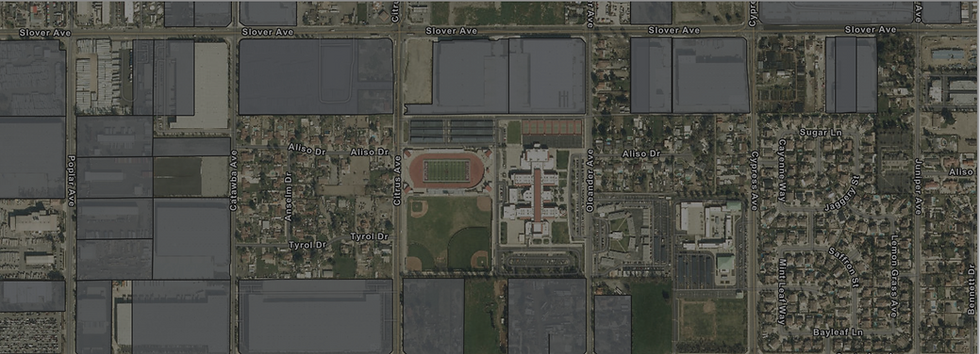
Bloomington 2022

Bloomington 2026

-
Warehouses are sprawling outwards, with new growth concentrated in the Antelope Valley, the High Desert (Victorville/Hesperia/Apple Valley), and Riverside’s growing mid-county (Banning/Beaumont/San Jacinto/Perris/Menifee).
-
Warehouse vacancy rates went from a record low of 0.9% to a more normal 6.3% and asking rent prices dropped from $1.61 per sq.ft. to $1.10 per sq.ft1. Availability rates that include subleases are 11.8% of space, indicating continued soft demand for space. In Q1 2026, there is a 20+% vacancy rate for Inland Empire East buildings between 250-500k sf.
-
Some Inland cities have the equivalent of a house's worth of warehouse space per capita. Warehouse construction competes directly with housing in high-need communities. Despite our housing crisis and many municipalities failing to meet RHNA goals, warehouse growth results in the demolition of existing homes and widespread rezoning from residential to industrial.
-
Some environmental policies to reduce freight pollution did not receive U.S. Environmental Protection Agency approval (for example, Advanced Clean Fleets and In-use Locomotive Rule). In addition, the federal government has voted to overturn the EV mandate entirely, which, along with similar changes, will prevent the attainment of national ambient air quality standards.
-
Despite the significant increase in new warehouse space in the last three years, there are now fewer jobs in the Wholesale Trade, Warehousing, and Transportation employment categories than during the peak pandemic employment month of November 2021 and the year of 2022 according to CA EDD LMI data.
-
According to an analysis by the Institute for Spatial Economic Analysis, 75% of warehouse jobs, and almost two-thirds of transportation jobs and wholesale trade jobs are vulnerable to automation.
-
Current federal policy is now discouraging international trade through tariffs. Global trade is threatened through international conflict and climate change. Our region with warehouse overconcentration is particularly susceptible to these shocks.


Request #1
Develop and implement more stringent standards for permitting and approval of freight facilities in environmental justice and disadvantaged communities.
Request #2
Require a logistics mitigation fee for the Inland Empire to account for negative externalities of the goods movement, similar to the TMF at the Ports of Los Angeles and Long Beach.
Request #3
Prohibit the demolition of existing housing or rezoning from residential to industrial for municipalities that have not met at least 75% of their affordable very low, low, and moderate income RHNA housing targets.
Request #4
Minimize and eliminate freight externalities and costs by reducing distance traveled and shifting mode share. Apply policies for smart growth, compact development, densification, infill, and mode-share to freight.

Request #5
Implement transportation demand-management policies that restrict freight land-use to below population growth rates to avoid industrial land uses competing with housing needs.
Request #6
Mandate the calculation of freight VMT in CEQA review–and count ALL trips associated with a project, not just passenger vehicles and home-based-work employee trips.
Request #7
Provide guidance on estimating projected future jobs due to automation and AI for CEQA documents.
Request #8
Encourage state-funded pathways for economic diversification in the Inland Empire, including economic reshoring, to decrease risk and protect the region against supply chain volatility due to climate, security, and trade policy instability.

Freight-related industrial real estate uses harm communities, narrow economic diversification, and remove opportunities for new housing as well as displacing residents from existing housing. Over-concentrated clusters of warehouses has locked the Inland region into a land-use pattern that is unsustainable for short- or long-term economic and environmental health, that increases heat and congestion, and that erodes quality of life. Freight policy needs to minimize and mitigate external costs including air quality, traffic, land-use, noise, and economic opportunity; reduce distances traveled to avoid logistics sprawl, account for the existing overconcentration of this sector through robust cumulative impact analysis, and protect the most vulnerable communities from predatory zoning and land-use decision-making.
We seek remedy for policy contradictions regarding industrial sprawl, air quality, and carbon emissions goals and housing.
We ask for meaningful state and regional engagement regarding additional protections for environmental justice communities, and for a way to achieve community-engaged regional planning that accounts more holistically for the impact of warehousing on human and environmental health and quality of life.